
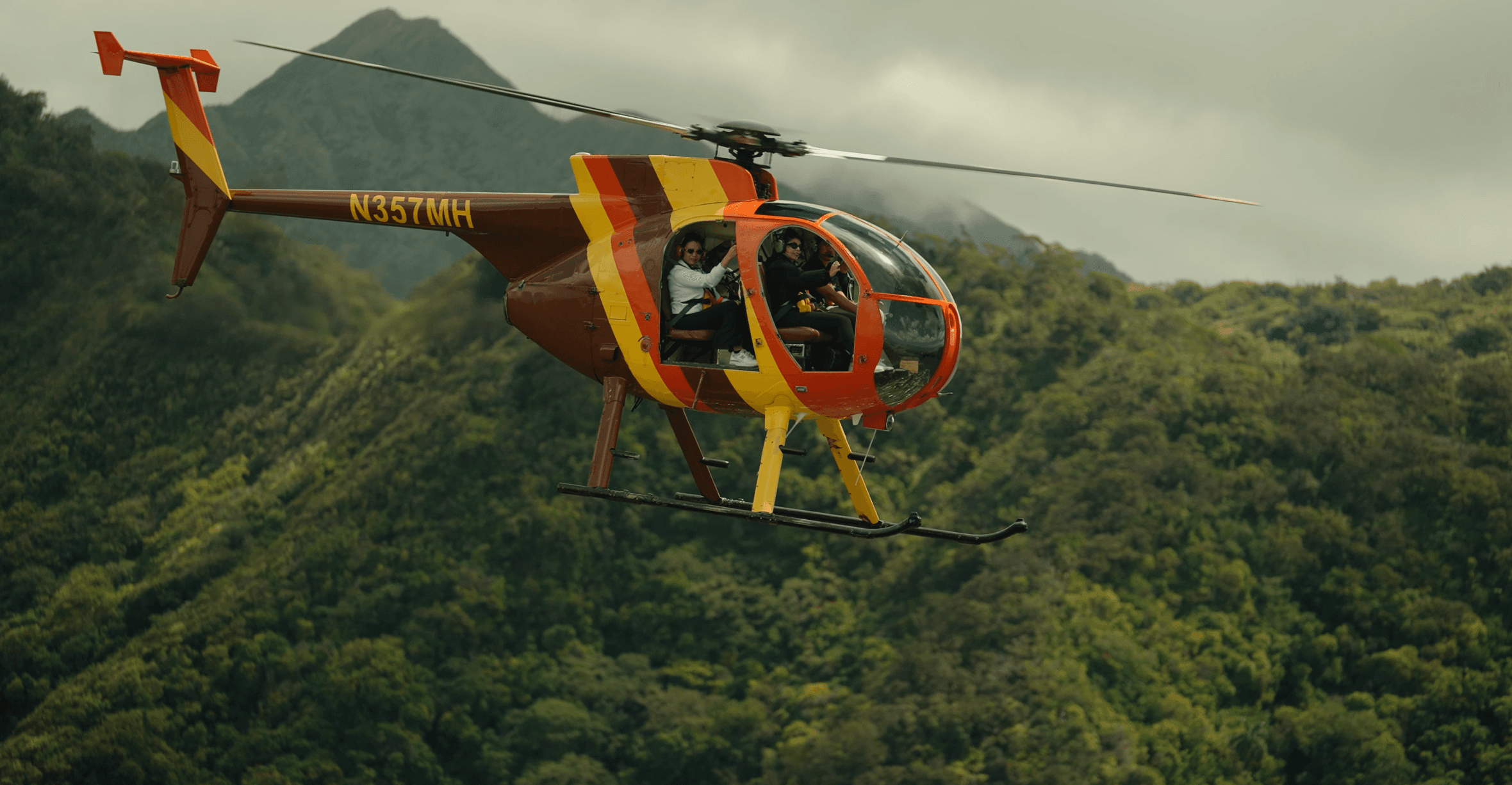
Your first helicopter tour is one of those things that's hard to prepare for mentally. You can read the brochure, watch the promo video, scroll through a hundred Instagram posts — and none of it quite captures what it actually feels like when the rotor spools up and the ground drops away. The noise, the lift, the moment when Oahu opens up beneath you in every direction — it's sensory overload in the best possible way.
This guide walks through the full experience step by step, from what to wear to what you'll feel at takeoff. We cover the logistics that matter, the sensations nobody warns you about, and a few things other guides skip entirely — the honest stuff that actually helps you choose the right flight and show up prepared.
We've sent hundreds of visitors into the air over Oahu. Here's what we tell every single one of them before they go.
Before You Go — What to Wear and Bring
What you wear on a helicopter tour matters more than you'd think — especially on a doors-off flight. Start with dark, fitted clothing. Loose fabric catches the wind and flaps relentlessly when the doors are removed, which is distracting for you and everyone sitting nearby. White clothing creates glare and reflects in windows and photos, washing out your shots. Stick with darker tones — navy, black, charcoal — and make sure nothing can blow away.
Shoes: Closed-toe footwear is required by every operator on Oahu, no exceptions. Sneakers or hiking shoes work perfectly. Leave the sandals and flip-flops at the hotel. This is an FAA safety requirement, not a suggestion.
Sunglasses: Bring a pair with polarized lenses if you have them. Polarization cuts through the ocean surface glare and lets you see the reef detail from altitude. Most pilots wear polarized lenses for the same reason.
Camera and phone: Secure everything. On doors-off flights, a phone lanyard or wrist strap is mandatory — operators will not let you fly with an unsecured device. GoPros with chest mounts are popular among photographers. Selfie sticks are never allowed on any flight.
Sunscreen:You're closer to the sun at altitude, and doors-off means direct UV exposure on your face and arms for nearly an hour. Apply a solid layer before you arrive at the heliport — there won't be time during check-in.
Leave the large bags at your hotel. There's no room in the cabin for anything bigger than your pockets. Drones are FAA-prohibited near heliports. Hats will fly off the instant you lift on a doors-off flight. Loose scarves and dangling jewelry are a safety risk around harness mechanisms.
One tip we always share: wear a dark long-sleeve layer. It blocks the wind chill on doors-off flights — the temperature drops noticeably at altitude — and it photographs cleanly against the sky and ocean backdrop.
Check-In and the Weigh-In
Arrive at least 30 minutes before your scheduled departure. This is non-negotiable across every helicopter operator on Oahu. If you're late, you miss the flight — no exceptions, no refunds, no rebooking. Traffic from Waikiki to the heliport can be unpredictable, so build in a buffer.
The part nobody talks about beforehand: the weigh-in. Every helicopter operator weighs passengers at check-in. It's not personal and it's not optional — it's physics. Weight distribution determines seat assignments and whether the flight can safely operate within its performance limits. If this makes you uncomfortable, know that it's done discreetly, usually on a scale behind the check-in counter, and the staff handles it professionally every single day. They genuinely do not care about the number. They care about balance.
Seat assignments come from the weigh-in, not from who booked first or who asks nicely. The pilot needs specific weight in specific seats to keep the aircraft balanced. You might not sit where you hoped — that's normal and not worth stressing about.
The safety briefing is thorough and quick. Staff will walk you through the harness system, point out emergency procedures, and cover the ground rules: no leaning out of the aircraft, arms inside the harness at all times, follow the pilot's instructions without hesitation. You'll sign a standard waiver — the same kind you'd sign for any adventure activity in Hawaii. Then your personal items get locked up, and you walk to the helipad carrying only what fits in your pockets plus your secured camera or phone.
The Takeoff — What It Actually Feels Like
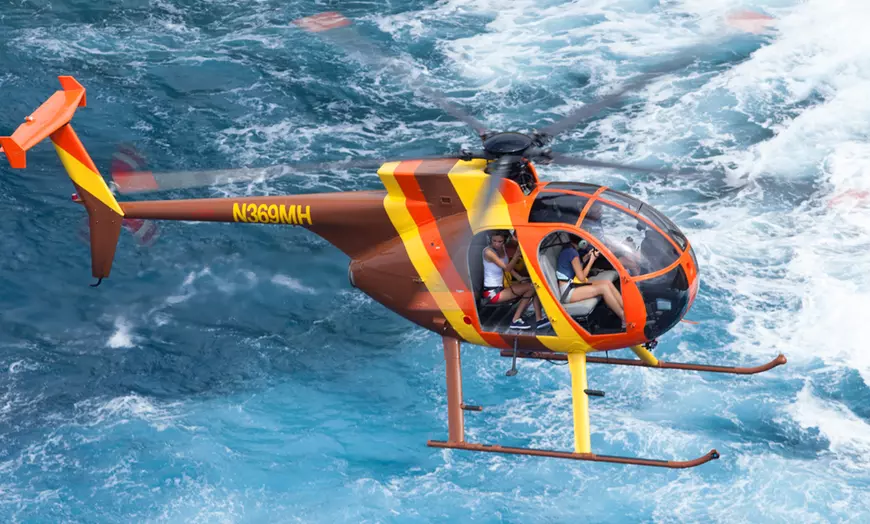
The rotor spools up, and the first thing you notice is the sound. It's loud — louder than you expect, even with the noise-canceling headset dampening it to a manageable hum. The whole aircraft vibrates with a purposeful, mechanical energy that you feel in your chest and your seat. It doesn't feel fragile. It feels powerful.
Your headset clicks on and the pilot's voice comes through clearly, calm and practiced. There's something reassuring about it — they've done this thousands of times, and it shows. A quick check that everyone can hear, a few last-second reminders, and then the lift begins.
The ascent is gentle and unmistakable. One moment you're sitting on the helipad; the next, the ground is pulling away beneath you. It's nothing like a plane — there's no runway, no horizontal acceleration, no gradual climb. Just vertical movement, straight up, and then a smooth bank as the pilot points the nose toward the first landmark. The helipad shrinks to the size of a postage stamp in seconds.
The first 30 seconds are the most intense. Your body hasn't caught up with your eyes yet. There's a disconnect between what you're seeing — the ground falling away, the horizon tilting — and what your inner ear expects. It's not nausea, exactly. It's a heightened awareness that fades quickly as the flight smooths out and the views take over.
Within a minute, you're banking over the first landmark. The pilot narrates everything — history, geology, local stories — and the headset makes it feel like a private conversation, even with a full cabin of passengers. On doors-off flights, the wind is real. Not violent or threatening, more like driving with the windows down at highway speed. It's exhilarating rather than scary, and after the first few seconds you stop noticing it entirely.
The moment the coastline opens up beneath you — reef colors you've never seen from any beach, the full scale of Diamond Head from directly above, the way Waikiki looks like a toy city pressed between mountains and ocean — that's when it clicks. That's the moment everyone talks about when they land.
What You'll See From the Air
The standard doors-off tour covers Oahu's greatest hits in a single sweep, and the route is designed so the landmarks build on each other. Each one is impressive on its own, but the cumulative effect — seeing the entire island unfold in sequence — is what makes the flight memorable.
Pearl Harbor is emotional from any angle, and from the air you grasp the full scope in a way that ground-level memorials can't convey. The USS Arizona Memorial, the harbor layout, the surrounding military installations — the pilot usually pauses the narration briefly here out of respect, letting the view speak for itself.
Diamond Head looks completely different from above. You can see inside the crater — the hiking trail switchbacks, the old military bunkers, the reef shelf that extends from its seaward base into water so clear it looks backlit. From ground level, Diamond Head is a silhouette. From the air, it's a geological story.
Waikiki and Honolulu reveal a contrast that's invisible from street level. The dense urban grid of Honolulu presses right up against the Ko'olau mountain range — there's almost no transition zone. At 2,000 feet, the entire city looks compact, a narrow strip of civilization between volcanic peaks and open ocean.
The North Shore coastline is seasonal drama from altitude. During winter months, the surf breaks are clearly visible — white water lines stretching along the coast like chalk marks on a blue slate. In summer, the same water is perfectly flat glass, and you can see the reef structure all the way to the horizon.
The Ko'olau Mountains and Sacred Falls are the greenest thing you'll ever see. Sacred Falls is a 1,100-foot cascade that's been closed to hikers since 1999 after a deadly rockslide — the only way to see it now is from the air. The valleys behind the mountains are so deeply cut they look like they were scored with a blade.
The reef shows colors that are invisible from the beach — deep blues giving way to electric teals, coral patterns traced like fingerprints across the ocean floor. On clear days, you can see bottom detail from altitude that snorkelers would envy.
A photography tip: shoot through the open door side whenever possible. Keep your elbows tucked and your arms within the harness. Burst mode works well for moving shots — the helicopter is constantly in motion, so single-frame timing is difficult. Wide-angle lenses capture more of the landscape than you'd expect.
The Landing and After
The descent is smooth — pilots approach at a gentle angle, gradually slowing and lowering rather than dropping straight down. Touchdown itself is soft, almost anticlimactic after the intensity of the flight. The entire experience from takeoff to landing is remarkably controlled, and that controlled precision is part of what makes it feel safe even when it feels thrilling.
After landing, most operators offer group photos on the tarmac with the helicopter. The pilot is usually happy to answer questions and talk through what you saw. If you noticed something during the flight you couldn't identify, ask — they know every ridge, every reef, every waterfall on the route.
Tip etiquette is straightforward: $20–$40 per person is standard for pilots. Cash is preferred. Tipping isn't required, but good pilots earn it, and the ones flying doors-off routes on Oahu are genuinely skilled at their craft.
The post-flight feeling is a buzz that lasts for hours. You'll want to talk about it immediately. You'll check your photos before you even reach the parking lot. For the rest of your trip, you'll see the island differently — every mountain, every stretch of coast, every reef break will carry the memory of what it looked like from above.
What Most Guides Won't Tell You
Helicopter tours are genuinely spectacular. Every visitor we've ever sent into the air has come back saying it was worth it. These aren't negatives — they're the honest details we wish someone had told us before our first flight, so the experience matches the expectation.
You share the cabin with strangers. Unless you book the private landing tour ($2,599 for the whole aircraft), you're flying with 3–4 other people you've never met. Everyone tends to be friendly and excited, but it's not the intimate, personal experience that the marketing photos suggest. Those promotional shots with one happy couple in an empty helicopter? That's the private tour, not the standard one.
Seat assignment isn't your choice. It's based entirely on weight distribution. You might end up in the middle row or on the side facing away from the best views on certain legs of the route. Doors-off flights mitigate this significantly — with no doors, even interior seats have better sightlines — but it's still a factor worth knowing about.
Windows can cause glare. Even on doors-off flights, if you're seated in the back, there's still some airframe between you and certain angles of the view. The front seats are the money seats for photography, and you can't request them.
Flight time includes transit. The advertised 50-minute flight time includes flying to and from the scenic route. Actual time spent over landmarks is closer to 35–40 minutes. That's still incredible and densely packed with views — just calibrate your expectations so you're not watching the clock.
It's loud. Conversation with fellow passengers isn't possible once the rotor is spinning. All communication goes through the headsets via the pilot. Some people find this isolating; others love the forced presence of it — just you, the views, and the pilot's narration with nothing else competing for attention.
None of these are dealbreakers — they're just the details we wish someone had shared before our first flight, so the reality matches the expectation.
An Alternative Worth Knowing About
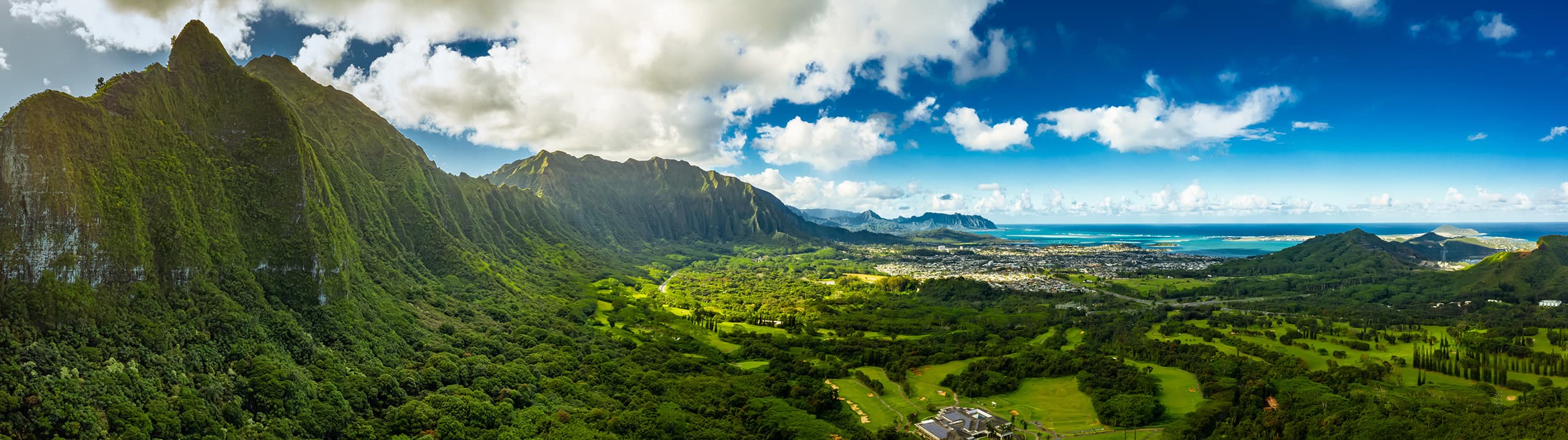
If any of those trade-offs made you pause — the shared cabin, the altitude, the seat assignment lottery — there's another way to fly over Oahu that solves all three. The gyroplane is an aircraft most visitors have never heard of, and once you understand it, you'll see why it appeals to a certain kind of traveler.
It's just you and the pilot. Open cockpit — no windows, no cabin walls, no plexiglass between you and the sky. The view is 270 degrees of unobstructed air. The rotor isn't engine-driven; it autorotates from airflow, which makes the ride remarkably smooth and quieter than you'd expect from an aircraft with a spinning blade overhead.
Gyroplanes fly at roughly 1,000 feet — low enough to see individual fish on the reef, spot sea turtles cruising below the surface, and feel the texture of the waves beneath you. It's not the sweeping panoramic view of a helicopter at 2,000 feet. It's the details. The things that make you feel like you're actually part of the landscape rather than observing it from a distance.
Skyland Air operates gyroplane discovery flights from Dillingham Airfield on Oahu's North Shore — away from the tourist corridors of Waikiki and Honolulu. The route covers the North Shore coastline, Kaena Point, and the Waianae Mountains. It's a different lens on the same island: coastal and intimate where the helicopter is panoramic and dramatic.
At $249 per person, it's less than a single seat on a standard helicopter tour. It's not a helicopter replacement — the routes and coverage areas are different, and you won't fly over Pearl Harbor or Diamond Head. Think of it as a complementary experience, or an alternative for anyone who values privacy, low altitude, and open air above all else. Read the full helicopter vs. gyroplane comparison for a detailed side-by-side breakdown.
Quick Checklist
- Book direct for the best pricing — no third-party markup
- Arrive 30 minutes early — no exceptions, no refunds for late arrivals
- Wear dark, fitted clothing and closed-toe shoes
- Secure your phone with a strap or lanyard
- Apply sunscreen before you arrive at the heliport
- Bring polarized sunglasses for reef visibility and photo quality
- Tip your pilot — $20–$40 per person in cash
- Consider the gyroplane if you want a private, open-air experience from $249