
If you're asking whether a helicopter tour on Oahu is safe, you've already done the right thing. Most people book an aerial tour the same way they book a luau — point, click, show up. Thinking about safety first means you're going to make a better decision, whatever you end up booking.
Here's the honest answer: helicopter tours on Oahu are generally safe, but “safe” is a word that hides a lot of nuance. Safety in aviation is about probability, operator discipline, and the kind of decisions that happen long before the rotors start spinning. This article walks through what actually makes a flight safe, what causes the incidents that do happen, and a structurally different alternative that most visitors never hear about.
No fear-mongering, no sales pitch. Just the information that lets you book with your eyes open.
The Honest Safety Picture
Commercial air tour operators in Hawaii fly under FAA Part 135 rules — the same regulatory framework that governs charter airlines and air ambulances. That means required maintenance intervals, inspection logs, pilot qualification minimums, drug and alcohol programs, and mandatory cancellation triggers for weather. It's the stricter end of general aviation.
Hawaii runs many thousands of tour flights every year. The vast majority complete without any incident at all. When something does go wrong, it tends to make the news precisely because it's unusual. That news coverage is what makes the risk feel larger than the actual numbers.
Unusual isn't the same as impossible. Hawaii's geography — steep terrain, fast-changing weather rolling off the ocean, narrow valleys that can trap aircraft in deteriorating conditions — puts real pressure on pilot judgment. The difference between a routine flight and a dangerous one is almost always made on the ground, in the decision to go or not go.

What Actually Causes Helicopter Tour Incidents
Looking at past tour-aviation investigations in Hawaii, the same themes recur. Mechanical failure is rare. What causes most incidents is a smaller list than people think:
- Weather decisions. Continuing into deteriorating visibility, pressing on through a mountain pass as clouds close in, or failing to turn back when a ceiling drops. Hawaii's weather changes in minutes. A good pilot cancels. A rushed pilot pushes through.
- Terrain proximity. Tours that fly close to valleys and ridgelines have less margin for error. A sudden gust or distraction at 200 feet from a cliff face leaves almost no time to recover.
- Operator culture. Does the company reward pilots for canceling, or pressure them to fly? Is maintenance treated as a cost to minimize, or a standard to exceed? You can't see culture from the outside — but it leaks through into reviews, into pilot turnover rates, and into how the company handles cancellations.
- Fatigue and scheduling. Operators that run pilots too hard or schedule flights back-to-back in marginal weather accumulate risk that eventually catches up.
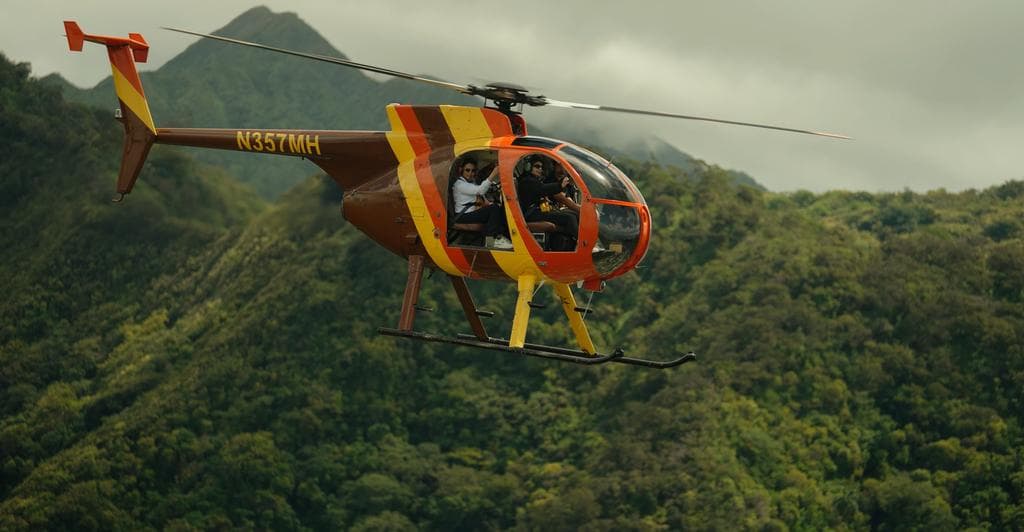
The aircraft themselves are rarely the problem. The Hughes 500D (MD 500), a long-established doors-off tour helicopter flown on Oahu, is a proven airframe with decades of operational history. What varies is the operator flying it.
How to Evaluate a Tour Operator's Safety Posture
The best way to book a safe flight is to book with an operator whose safety culture is visible in how they do business. Here's what to look for, and what to ask if you want to push deeper:
- FAA regulatory category. Commercial air tour helicopters operate under FAA Part 135 — the air carrier certificate that governs charter operations, with strict maintenance and pilot standards. Flight-instruction operations, including gyroplane discovery flights, operate under Part 91 general rules with FAA-certificated flight instructors. Both are legitimate regulatory frameworks with FAA oversight — ask the operator which one they fly under, and how long they've held it.
- Pilot experience. How many hours does your pilot have on this aircraft type? Many working Hawaii tour pilots have 2,000+ hours on type, and more is better. There's no official threshold — just ask, and listen to how readily the operator answers.
- Cancellation policy. This is the single most important signal. Operators with a relaxed, no-hassle weather-cancellation policy are telling you they'd rather lose the revenue than fly a marginal mission. That's exactly the posture you want.
- Review patterns. Look for reviews that mention the pilot's decision-making — “he cancelled our flight for weather” or “she chose a different route because of winds.” That's the sound of a safe operation. Five-star reviews about the pretty scenery are less informative.
- Pre-flight briefing. A thorough, unhurried pre-flight briefing — not a thirty-second recitation — is a cultural marker. It tells you the operator takes the passenger role seriously.
Wait — Is Doors-Off More Dangerous?
One of the most common fears we get asked about is doors-off flight. The intuition makes sense: no door must mean less safe. The reality is that it doesn't work that way.
Passengers on a doors-off helicopter tour are secured by an FAA-approved harness system attached directly to the airframe. The harness is tested to take loads far exceeding what any passenger movement could produce. The door being removed doesn't change how the helicopter flies, how it's maintained, or how the pilot handles it. It changes your field of view and your ability to take unobstructed photos. That's it.
Doors-off is a standard, long-established configuration flown daily across Hawaii and used constantly in film and photography work. You should evaluate the operator, not the door.
The Alternative Most Visitors Never Consider
There's a small aircraft flying out of Dillingham Airfield on the North Shore that's built around a very specific principle: the entire emergency maneuver helicopters rely on, a gyroplane does continuously, as part of normal flight.
It's called autorotation. In a helicopter, if the engine fails, the pilot immediately lowers the collective, lets airflow spin the rotor from below, and glides to a landing. It's a trained recovery. A practiced helicopter pilot handles it routinely in training, and it works — but it's a reactive maneuver that depends on recognizing the failure and responding correctly.
A gyroplane is already in autorotation at all times. The rotor is unpowered — it spins freely on the airflow across the blades whenever the aircraft moves forward. The engine only drives a rear propeller for forward thrust. If the engine quits, nothing changes about the rotor. The gyroplane simply glides down, under the same continuously-spinning rotor it was flying on a moment before. There's no maneuver to execute. No collective to dump. Just a glide.
Combined with a cruise altitude of about 1,000 feet over the North Shore — mostly open coastline, beach, and water — and a landing speed slow enough that a gyroplane can put down in a space the size of a residential driveway, the aircraft has a notably forgiving failure profile. That's not marketing language. That's how the aircraft is built.
To be clear: no aircraft is risk-free, and gyroplanes have their own envelope to respect. Their safety, like any aircraft's, still depends on the pilot discipline, weather judgment, and maintenance standards that make helicopter tours safe. What the continuous autorotation gives you is a specific, structural answer to the one scenario most nervous passengers actually fear: what happens if the engine stops.
The gyroplane discovery flight also runs with a different operational model. Skyland Air flies a single passenger per flight and operates from a quiet North Shore airfield with minimal traffic. The pilot is a certificated flight instructor, and the briefing is conducted as flight instruction — consistent with FAA guidance.
How to Decide
If safety is your primary concern but you still want to see Oahu from the air, you have two strong options, and neither of them is wrong.
Book a doors-off helicopter tour with a proven Part 135 operator, ask the right questions, and accept that aviation risk — while real — is statistically very small in Hawaii tour flying. Helicopters offer the panoramic, cover-the-whole-island experience that's impossible any other way.
Or book a gyroplane flight and fly in an aircraft whose design answers the engine-failure question by being continuously in the recovery state. You'll see less of the island overall, but you'll see the North Shore in a kind of detail helicopters can't offer — and you'll be flying one-on-one with an instructor, not in a cabin with five strangers.
If you're nervous, the gyroplane is the move. Not because helicopters are dangerous — they're not — but because the gyroplane experience is structurally calmer by design. Low altitude, open air, one passenger, a pilot-instructor giving you their full attention, and an aircraft that doesn't need to react to engine failure because it already flies the way helicopters fly during recovery.
Frequently Asked Questions
Are Oahu helicopter tours dangerous?
Statistically, no. The vast majority of tour flights on Oahu complete without incident. Risk is not zero, but it's low enough that many thousands of visitors fly every year without trouble. Your risk depends far more on the operator you pick than on the activity itself.
What's the safest aerial tour on Oahu?
Both helicopter and gyroplane flights have strong safety records when operated by certified companies. Gyroplanes have an inherently stable glide profile because they fly on continuous autorotation. Combined with low altitude and slow landing speed, this makes them a structurally forgiving aircraft. For helicopters, the single best predictor of safety is operator culture — weather discipline, pilot experience, and a relaxed cancellation policy.
Is a gyroplane safer than a helicopter?
They handle emergencies differently. A helicopter pilot enters autorotation as a recovery maneuver after power loss. A gyroplane is in autorotation all the time — the rotor always spins on airflow, not engine power. An engine failure in a gyroplane doesn't change how the rotor behaves; the aircraft simply glides. That's a notably forgiving failure profile for the engine-out scenario. No aircraft is risk-free, though — gyroplane safety still rests on the same pilot discipline, weather judgment, and maintenance standards that make helicopter tours safe.
How do I pick a safe Oahu helicopter tour operator?
Confirm which FAA regulatory category the operator flies under — Part 135 for commercial air tour helicopters, or Part 91 with Part 61 certificated instructors for flight-instruction operations like gyroplane discovery flights. Ask about pilot flight hours on the aircraft type, read reviews for mentions of weather cancellations, and look for operators whose cancellation policy is relaxed rather than punitive. A company that cancels easily is a company that doesn't feel pressure to fly marginal missions.
Are doors-off helicopter tours more dangerous?
No. Passengers are secured by FAA-approved harnesses attached to the airframe. The door being absent changes your view, not the aircraft's airworthiness. Doors-off is a standard configuration flown daily across Hawaii.